Saturday, October 5, 2019

A Side Pedal Fox (#006)

This gun was first shown in stock form here: https://vicknairgunsmithing.blogspot.com/2018/10/another-high-condition-smallbore.html but it's not going to have much in common with its former self when it's done.

Making an entire gun of one's own design, from scratch isn't the easiest thing to do, but redesigning an existing gun can be far more difficult since one has to "work around" certain design elements that simply can't realistically be altered.  That said, I can truthfully state that this project is the most challenging, from a creative standpoint, that I've yet undertaken.  That's not only because of the side pedal but also the "island" safety, but I get ahead of myself, allow me to fill in some back story.  A few years back, Beretta unveiled a double that they dubbed (double? dubbed? Ha, I kill me!) the "Serpentina".  This gun was quite a departure from anything that had been seen prior, as it was completely smooth, sidelever operated, had the aforementioned "island" safety and highly polished barrels left in the white.  Now, none of these things individually are without precedent but the way in which Beretta combined them resulted in a gun that was unlike anything anyone had ever seen before.  To say that the gun was polarizing may be a bit of an understatement.  The "traditional gun guys" didn't get it while some others saw it as the bold artistic statement that it was meant to be.  The owner of this Fox was quite taken with the Serpentina and contacted me about making something that pulled inspiration from that gun without being an outright copy, something that was just as slick and smooth but which looks more like a gun than a used bar of soap.  The sidelever and island safety were must-haves, as was the completely bald, smooth look but he wasn't particularly keen on the actual shapes of the Beretta.  For the "raw material", I had suggested a Fox, so a Philly-made 16 gauge Sterlingworth was found that had mint bores and also ejectors (another must-have for the client), then the design, or more accurately, the redesign work began.  Shortly thereafter, Beretta raised the bar by presenting the "Serpentina Black" which was again, completely smooth but this time all of the metalwork was finished in deep black and the gun was stocked in  highly polished Gabon Ebony resulting in a gun that was blacker than a Spinal Tap album cover.  Personally, I thought it looked great.  I've long had an idea in the back of my mind for what I call the "Duesenberg" gun, that would be a gun with all of the metalwork left in the white and perfectly polished, with the "wood" finished in a deep gloss black lacquer, along with a few other car-inspired touches.  I guess it could be called the "black and white" gun as well but it was a Duesenberg coupe that gave me the idea, hence the name.  Obviously, the lacquer stock finish would preclude the gun's being used in any remotely realistic way, which is one reason the project had never progressed beyond the idea stage.  I'd never actually considered stocking a gun in ebony until I saw the Serpentina Black, mainly because I'd always assumed that pieces of ebony that big were unobtainable.  Realizing that that was an actual option and having secured a suitable billet of ebony (you think English walnut is pricey?), I contacted the client and suggested that we go with the "black and white" motif.  He enthusiastically agreed.  The gun will be completely devoid of engraving, checkering and even screw heads, in other words, completely smooth.  Achieving this look necessarily also means that the relief cut in the frame that accommodates the forend iron must be dealt with.  I've done that in the past with a spring-loaded, articulated cover but those were extractor guns.  The ejector mechanism in this forend doesn't leave much room for the cover mechanism but, where there's a will, there's a way.  Obviously, this is no cakewalk and will require major redesign and surgery but the end result will be like nothing else.  Here goes.

First off, here are a couple of photos of the gun as received.

Here are some of the parts that will not be used.  The topstrap, rib extension and forend lug will join this group as well.

 After complete disassembly, the frame and triggerplate were annealed and the topstrap was removed in preparation for the new leverless piece.  The dropped areas on the new topstrap are what will create the island safety.  Converting the gun from a captured stock to a drawbolt stock killed two birds with one stone.  It accommodated the island safety while hiding the breech screw in the most effective possible way, by getting rid of it.  That bar of 1020 with the blue arrows pointing to it is the material from which the new topstrap was made.

Once the design of the sidelever and bolting mechanism was proven using wood mockups (old-school rapid prototyping), the actual parts were made in the steels appropriate for their role.  Before I actually made the new bolt, and before the topstrap was welded in place, I took the opportunity to true up the bolt bore in the frame since they are neither round nor cylindrical as they came from the factory.  They're also about as rough as a corncob internally as well.  The form of the sidelever was taken almost directly from the Serpentina, per the client's request as that is his favorite single part of the gun.  Aesthetically, it will work well in this application.  Below are some photos of the roughed out sidelever and its inspiration, all prior to welding.

The topstrap/frame junction, after welding and rough shaping of the contours at the wood/metal interface.  The lever is roughly shaped and the bolt and link are made.  At this point, the only external frame shaping that's been done is that which is incidental to the structural modifications.  Once all of the internal mechanisms are made, I'll get to the external shaping.  The next items on the agenda are the return spring mechanism for the bolt and the safety mechanism, which will be unlike anything seen on a double, not a slide, roller or a lever.  In case you're wondering, no, the sidelever does not pivot on the sear pin axis.

When I filed up the new topstrap, I left the safety island high because the top line of the hand portion of the stock would define the height of the island.  Normally I don't start on the stock pattern until later in the process but much like when making a bar-in-wood design, the stock in this case determines the shape of certain elements, namely, the safety island.  So I had to mock up at least the hand portion of the stock.  The parts of the safety mechanism could not be made until the height and contour of the exposed surface was defined.

Here is the blank.  Even at this exposure, it's apparent how black this piece of ebony is.

The bolt operating and auto-safety mechanism.  Everything is still in the rough state and will be finished to the usual standards.


This is the portion of the sidelever that is driven by the above pictured lever.  A simple roller may have sufficed but this is even smoother.  Yes, it's an actual ball bearing.

The bolt closure and auto-safety linkage train.


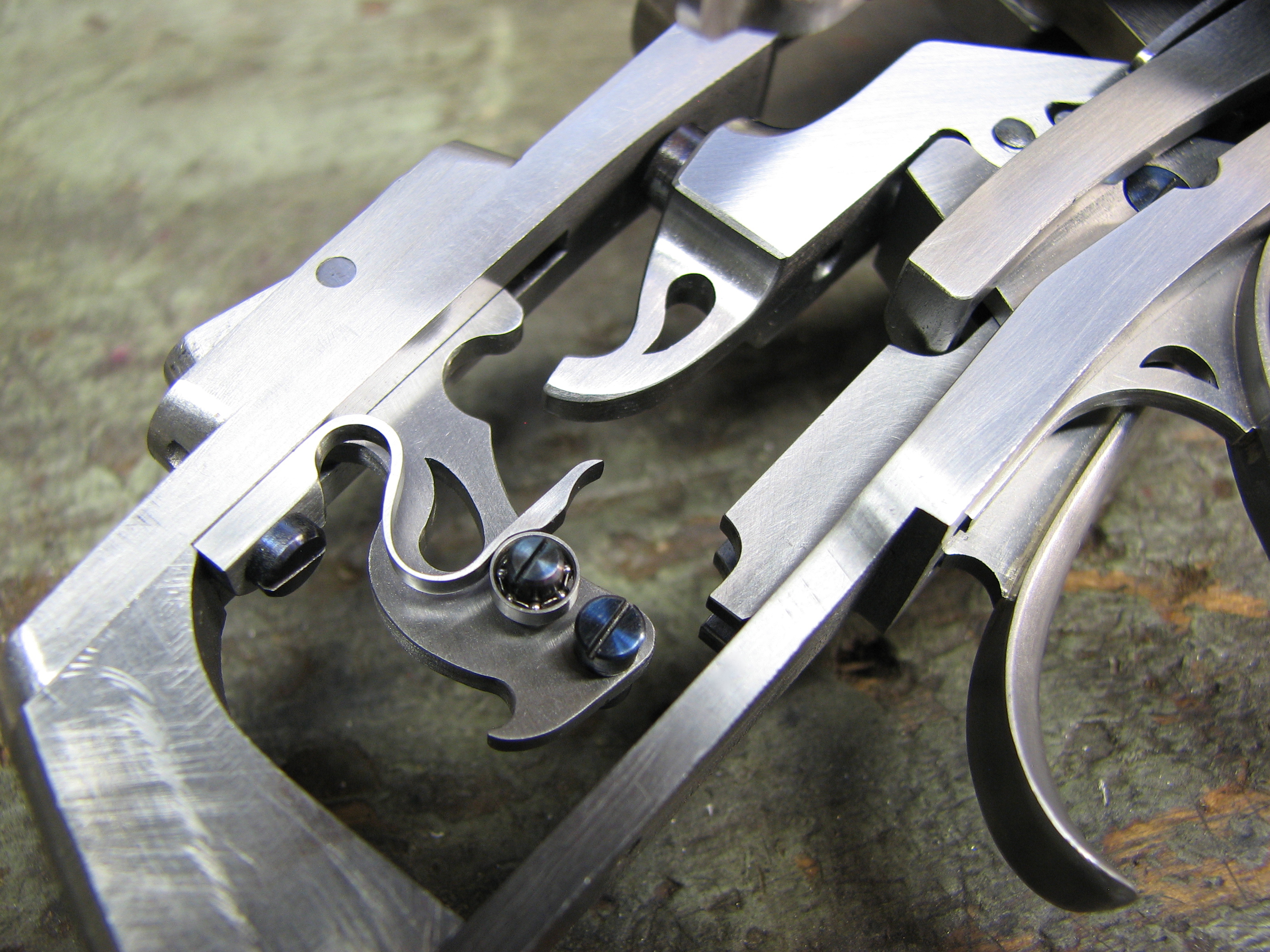
  A bit over three hundred hours from the start and it's again a functional gun, meaning that the bolting mechanism, lockwork, triggers and safety mechanism are made and fit.  Everything pictured is bench-made, from the solid, properly heat-treated according to the particular material and hand-polished.  The triggerguard will be made from the solid, rather than being fabricated, as is my usual practice.  Part of the reason for this is because of the mounting method that will be employed, wherein there are no visible screws.  Once that is finished, the external, cosmetic reworking can begin.  After the "ordeal" of the sidelever conversion, that will be a welcome change of scenery.

I took no before photos of the inner workings in their stock form, so here are some photos of a Philadelphia-made, A-grade small frame, for comparison.  Rumor has it that the "graded" guns were somehow "better finished" than the Sterlingworth.  Much like the myth that the Philly guns were better than the Utica guns, this one holds no factual merit either.

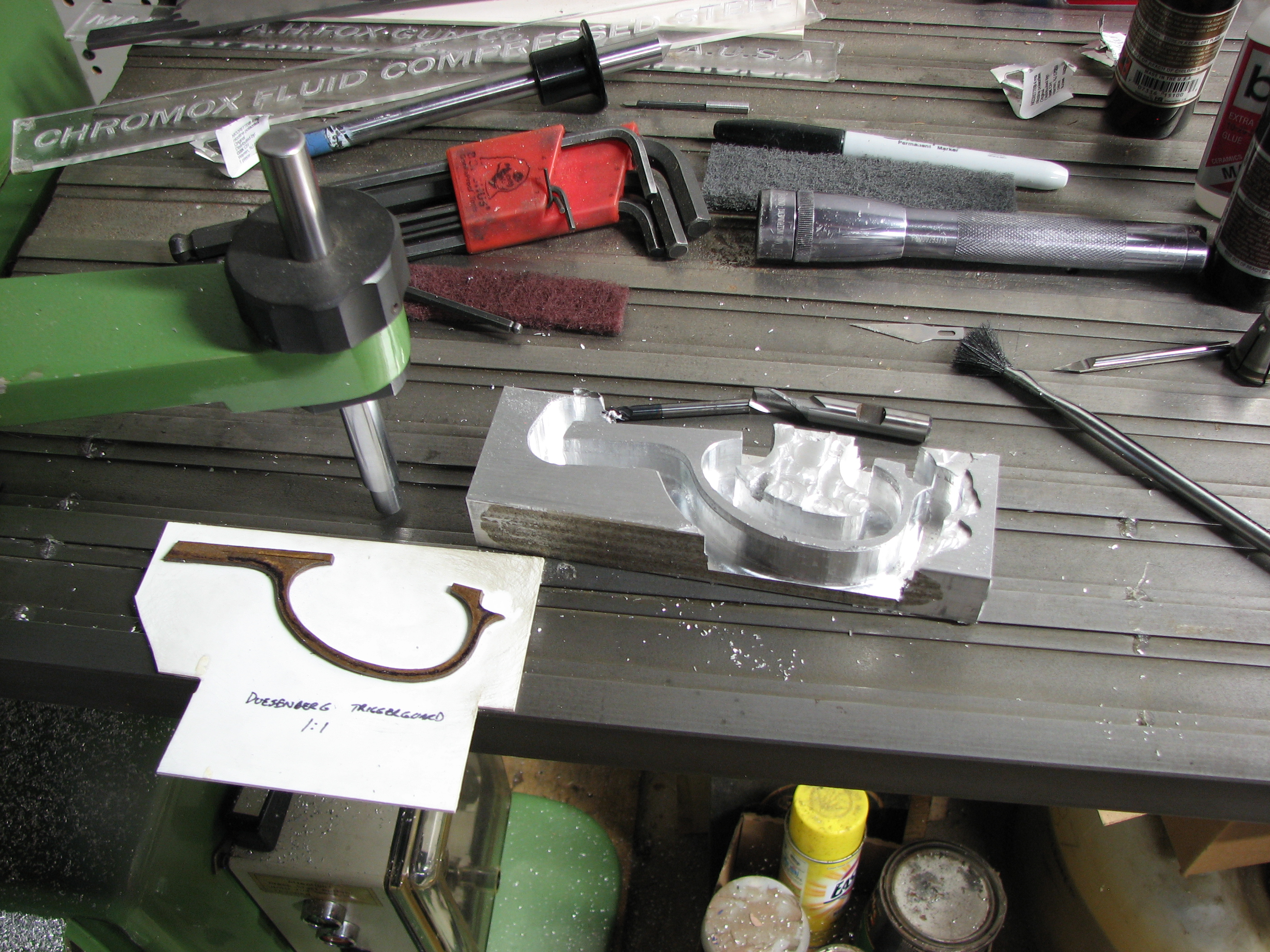
The side pedal and island safety conversion necessitated that the stock retention method be converted to a drawbolt (the block between the top and bottom straps is a temporary place-holder).  This, combined with the desired "look" of the gun, meant that I had to design the triggerguard in such a manner that its screws are not visible externally.  I made a template of the guard's profile, which I then used as a pantograph pattern.  Once the profile of the guard was cut out, I made the mounting hardware (a screw at the rear and a sliding dovetail in the front) and then shaped the guard by hand.


Friday, October 4, 2019

Updates

It's been a while since I've posted anything because I've been inundated with repair work (A.K.A. "dirty dishes" work) but with a portion of that out of the way, the interesting stuff can resume.

The scratchbuilt 28 gauge detailed here: https://vicknairgunsmithing.blogspot.com/2018/06/rising-bite-bar-in-wood-sidelock.html is is almost ready for stocking and then finishing.  Once I make the forend fastener and forend finial, I can begin with the stocking.  I found what, at the time, seemed like a nice blank but I think I'll save that for another project.  It's nice but not quite nice enough for this gun.  Rather than make multiple separate posts detailing the entire project, I'll simply add to the original post.  I think that this will make for a less confusing format as all of the information will be in one place.  Just click on the link and you will see the updated post. 

A couple more interesting custom Fox guns are in the works and will be posted so that you can follow along with those.  They are numbers 006 and 007.  Number 007 is an extensive cosmetic makeover but it's still mechanically a Fox.  Number 006 is something else entirely and the beginnings of that project will be posted presently.

Tuesday, August 27, 2019

Random Thoughts of a Dinosaur

Gunmaker vs. Gun Builder:

 I was reading an article in one of my favorite gun magazines about an up-and-coming gunmaker and was a bit taken aback by his response when asked by the author about his methods.  The author asked if his methods were similar to those taught to apprentices in the English trade of old (I'm paraphrasing).  His response was that they were not, and then he went on to describe how he designs each part of the gun (a quite conventionally designed gun, mind you) in "virtual reality" on a computer, using a solid modeling program and then the digital files are sent to an outside vendor to be produced using computer-controlled machinery.  The writer then states that the parts arrive "NEARLY FINISHED".  I know that everyone says that CNC is just "another tool in the gunmaker's toolbox" but I can't help but wonder: When a part or parts arrive needing little more than polishing in order to be assembled into a functioning gun, ready for engraving and finishing, is it really gunmaking?  Lest you think I exaggerate about how close to finished these parts really are, you might have a look at the website of one of the UK's leading suppliers of components to the trade.  Some of the shotgun parts "kits" are actually functioning guns, almost ready for stocking and finishing.  When a gunmaker purchases one of these component kits and stocks and finishes it (if he actually even does those operations himself), and then puts his name on it as the gunmaker, is this not a bit disingenuous?   I'm all for using machinery to save on the unskilled "donkey work", like roughing out a major component rather than using a hacksaw, but when the "gunmaker" no longer even has to shape the external contours, or indeed even touch a file to them, is he really a gunmaker?  I can hear it now: Shut up old man, your hammer and chisels are obsolete!  We don't have to do that anymore!  That may be so, but isn't part of the appeal of a best gun the artisanal aspect of it?  "Not having to do it" is the whole point.  I'm sorry, but assembling and finishing "nearly finished" parts does not take the skills of an artisan, a craftsman perhaps.  It would seem to me that the client is paying for something that he is not receiving when buying a CNC best.  There are those who (rightly) sneer at machine-made "engraving" but see no issue with a machine-made best gun.  A certain amount of hand work has always been implicit in the making of a best gun and I don't mean just hand polishing.  Since these gunmakers first create the gun in "virtual reality" on the computer screen, maybe we should refer to them as virtual gunmakers.  After all being shit-hot at playing Pole Position doesn't make you a real Formula One driver and being great at playing Call of Duty doesn't make you a real Navy SEAL.

How Many Gunmakers Does it Take to....?

The action comes from one "supplier", in the old days the locks came from another but now more than likely, they come from the action maker, the barrels come from another.  The gunmaker maybe assembles all of these components into functionality himself and then sends the works off to the stocker, after which it may go to the "finisher" if the gunmaker does not do this operation himself, then the gunmaker disassembles it all and sends the barrels off to be blacked, the frame to be color hardened, the stock and forend go to the checkerer, who knows who finishes the wood and, finally, everything comes back and the gunmaker assembles it with HIS name on it (I guess because there isn't space for everyone else's names).  I can not comprehend the idea of taking credit for the work of others, much less doing it pridefully.  Gunmakers will tell you that "everyone does it this way".  I've actually been told that no one can do everything himself.   That's flat out bullshit.

Did You Ever Wonder.....?

Why the British refer to screwdrivers as "turnscrews" while they refer to screws as "pins"?  Why not call the screwdriver a "turnpin" (probably because it looks too much like turnip when you see it)?  Perhaps we should just call it a screwdriver.  Admittedly not as haute as "turnscrew" but it describes the function just as well.  Why not also just call every threaded fastener that is driven with a bladed tool a... wait for it... "screw"?  That could work, it may even catch on.

Wednesday, July 31, 2019

Franz Jaeger BLE

This one came in for the repair of a dent in the right barrel, to have the chokes adjusted and replacement of a missing ebony and ivory inlay in the stock.  Since looking at photos of the first two procedures would be pretty boring, I only documented the replacement of the inlay.

Here is a photo of the stock, as it came in.

I cleaned the old glue from the pocket and then deepened it overall in order to give the glue joint a bit more purchase on the new inlay. 

You're probably wondering about that chunk of beef bone, I'll explain.  That is what I use in place of ivory because I don't use actual ivory for any application.  The beef bone is a waste product and the ends of the femur are big enough to get just about anything short of pistol grips from.  It machines, polishes, smells, looks and is indistinguishable from actual ivory.  If you think that you can tell the difference, you're quite incorrect.

 The finished job,

Here are some photos of a chunk of bone that I used to make the "ivory" portion of the inlay.  As I said, it works exactly like ivory in every way, including the smell and the ability to take a mirror polish.  There are quite a lot of beads in that piece alone.


Tuesday, July 9, 2019

Definitions

Words have definitions for a reason but like so many things in the gun world, the meanings of certain words have become, shall we say, "elastic".  Personally, I believe that a particular word's definition is written in stone, otherwise there is little point to having language at all.  Here are some of the gun world's more flexibly defined words.

Restoration:
 (actual meaning) - to return an item to its "as new" condition and configuration

(gun world meaning) - to sloppily refinish, usually including rounded corners and edges of metal and wood, smeared engraving, funneled screw and pin holes and incorrect finishes, often combined with half-assed repairs 

"As new" is not better than new, nor is it what typically passes for a restoration by the vast majority of the practitioners in this business.  A gun can only be correctly restored if the workman has detailed knowledge of how each part was prepped for finishing, the processes used at the factory for applying the finishes, the material the parts were made from and how they were heat-treated (if at all).  No factory-made gun ever left the factory as a perfect specimen of gunmaking (not even close, typically).  All factories tolerated less than perfect work in many aspects of the finished product.  A correct restoration will show these same "mistakes", where appropriate.  I did this type of work for a long time and am quite happy to say that I do it no longer.

Upgrade:
For this one, the gun world meaning is really the only one that matters.

(gun world meaning) - to take a low or field grade gun and embellish/finish it in a way that, as closely as possible, mimics a factory-offered higher grade version of the same gun

That pretty much covers what an upgrade is as far as guns are concerned.  Some however, might also refer to these as "custom" guns, which they most certainly are not, in any manner.  I've never seen the point to expending the time and energy necessary to create an upgrade, mainly because I've never been particularly impressed with anything "high grade" offered by a factory, which is why I never have, and never will, create an "upgrade" gun.  Slavishly copying something that already exists, especially something that was factory-produced, seems more than a bit unimaginative to me.

Custom:
(actual meaning) - made, or done, to order for a particular customer, unique*

(gun world meaning) - any deviation from original, no matter how trivial

This is one that gets misused possibly even more than restoration.  An AR-15, assembled with store-bought parts and accessories and spray-painted in a stars-and-stripes motif (I won't even get into flag etiquette)? Custom!   A shotgun with crappy aftermarket engraving?  Custom!   Any "factory custom" that can be ordered out of the catalog?  Custom!   A Winchester Model 70 with an aftermarket stock?  Custom!   A "windowed" and stippled Glock? Custom!
None of the above examples actually qualify as a custom gun.  They might qualify as "personalized" or "custom-ized" but nothing more.  If Joe Sixpack can duplicate it with a Discover card and a Dremel, it probably doesn't qualify.
A true custom gun (or anything else) is by definition unique*. 

*Unique: being the only one of its kind, unlike anything else

Mint Condition:
(actual meaning) - as new, like a freshly minted coin

(gun world meaning) - just about any condition, depending upon who is selling it

Actual mint-condition guns (old ones at least) aren't really that common.  What is common is for people to refer to guns that are anywhere from 85-95 percent condition as "mint".  These people are often dealers trying to justify an inflated asking price, or collectors trying to justify their paying an inflated asking price.  Also, no matter the condition, ANY discernible repair automatically removes a gun from the mint category.

Provenance:
(actual meaning) - a record of ownership of a work of art or an antique, used as a guide to authenticity or quality

(gun world meaning) - a nebulous quality that causes an otherwise unremarkable gun to magically be worth many times its actual value, usually by virtue of once having been owned by a "celebrity"

The idea that any product's value increases due to once being owned by a celebrity has always puzzled me.  Mere ownership by a celebrity creates no material change in the product and, in a rational world, would have no affect upon the item's value.  For example, a Parker of whatever grade once owned by Clark Gable is still just a Parker of whatever grade.  A beat-up Fox HE once owned by a racist outdoor writer unknown to most people, is still a beat-up Fox HE.  These people had no hand in the creation of these items, they merely bought them, or the company gave them as "gifts" (a.k.a. advertising).  Owning Clark Gable's Parker isn't going to transform you into Clark Gable, nor is it likely to make you a better shot.

Traditional:
(actual meaning) - produced, done, or used in accordance with tradition

(gun world meaning) - produced, done, or used in accordance with tradition

You may have noticed that the gun world's meaning matches the actual meaning this time, which, for better or worse, is pretty much true.  An example of the positive influence of tradition can be found in the overall configuration of the English side-by-side gun.  Unfortunately, in the gunsmithing realm, "traditional  methods" still carry on in instances where they should clearly be relegated to the trash heap of history.  One example is the "witchcraft" of springmaking, and many of the traditional methods of that particular bit of gunsmithing can't be described as anything other than witchcraft.  This should not be so because metallurgy and heat treatment of steel (and all other metals) are actual sciences, long understood and reality based.  One would never know this to hear the multitude of methods for heat treating a spring (I will not even get into the things one hears when discussing the material selection for a spring).  One will hear tales of all manner of "special" ingredients like sperm oil, tempering oil, lime (for covering?), blood and such.  There will also be cautions about such ignorant nonsense as "keeping the spring dark" (whatever the f*** that means) and the ever popular (and idiotic) "you either have a spring or you don't".  What you will almost never hear is a rational, reality based discussion about the effects of various temperatures upon the finished part, soak times, the various media used for accurate and controllable tempering, etc.  Where the fabrication or manufacture of any part is concerned, luck and hope should never be factors in the outcome. Everyone that subscribes to any of these "traditional" methods have two things in common: they never know if they will actually have a functional spring, or if it is functional, how many cycles it will survive.  They also demonstrate supreme ignorance, especially when one considers that the actual information is so readily available that would completely eliminate the "luck factor" from this particular operation. 
Case hardening is another process that seems to be shrouded in an impenetrable fog of bullshit-scented mystery (at least in the gunsmithing world).  Again, one hears of "mystical" ingredients, even including urine and human bone.  What is not heard (or explained) is why such ingredients might be needed.  What do they do, chemically?  Don't bother to ask questions, it's traditional, that's why.  It's unfortunate that materials science and actual engineering have largely passed the gunsmithing industry by.  It's also baffling because the materials from which guns have always been made, as well as the processes used, are so well understood in every other industry in which those same materials and processes are employed.  I suspect that many gunsmiths hold on to these "mysterious" methods in order to give the appearance of being possessed of more knowledge than they actually have.  Far too much in the gunsmithing trade is done in the way "it's always been done" rather than in the way it should be done, that is in a thoughtful, logical manner.  Tradition should never trump logic when dealing with mechanical devices (or most other things).

Heretic:
(actual meaning) - a person holding an opinion at odds with what is generally accepted

(gun world meaning) - Me

This one should be obvious by now.
 

That's it for now but I suspect that this list will grow (just a hunch).